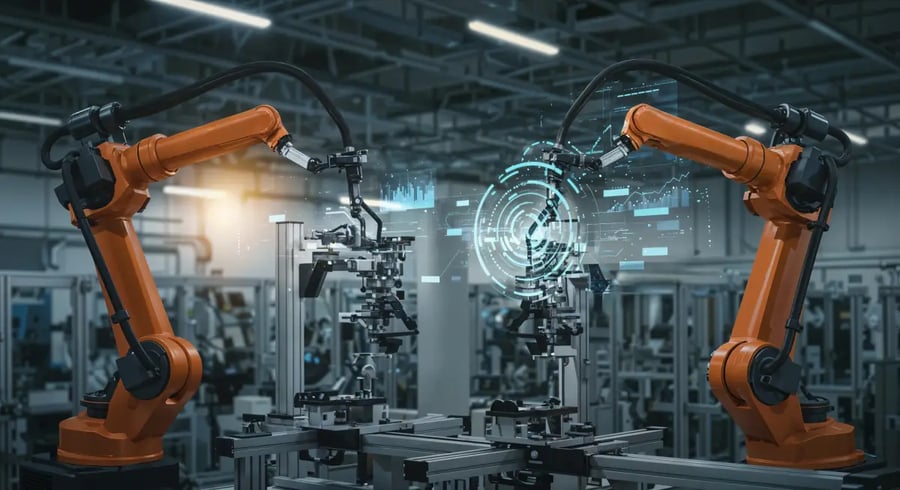
Manufacturing gets the highest average ROI from AI of any sector, at around 200%. But the number can be misleading. Some generative AI development services projects pay back in six months, while others take years or never deliver meaningful returns. The difference often comes down to choosing use cases for business value, not presentation value.
Below are seven manufacturing use cases in 2026, roughly ordered by how quickly they tend to pay back.
1. Technical Documentation and Work-Instruction Generation
This is often the easiest place to start because it does not directly affect production. Generative models can turn engineering specifications, CAD annotations, and legacy manuals into standardized work instructions and training material. Documentation and maintenance workflow automation can pay back within 6 to 12 months.
AI does not fix bad source information. If an old instruction is wrong, generative AI may simply rewrite it more clearly. Human review is still essential before content reaches the factory floor.
2. Maintenance Troubleshooting Copilots
Technicians can use copilots grounded in equipment documentation, service history, and live sensor data instead of searching long manuals. Predictive maintenance can identify failures 48 to 72 hours in advance and reduce unplanned downtime by 30 to 50%.
Incomplete or incorrect grounding can produce confident but unsafe answers. Most engineering effort should go into reliable data and context, not just the chat interface.
3. Defect Detection and Quality Reporting
Combining computer vision with generative reporting can detect defects at up to 99.5% accuracy while automatically producing written quality reports.
That does not eliminate human judgment. Even a small error rate matters on high-volume lines. AI ML development can reduce manual inspection and reporting work, but borderline parts still need experienced quality teams.
4. Generative Design for Component Optimization
Generative design tools can test thousands of structural alternatives against engineering constraints. Airbus used this approach to reduce the weight of an A320 partition wall by 45%, while manufacturers can shorten design iteration cycles by 40 to 60%.
This is not a quick win. It requires clean simulation data and engineers willing to evaluate machine-generated designs. Plan implementation in months, not weeks.
5. Supply Chain Disruption Scenario Planning
Generative AI can turn supplier, logistics, and operational signals into clear scenarios, such as what happens if a key supplier goes down next week.
But analysis creates value only when someone owns the decision. Without clear responsibility for acting on disruption scenarios, the output becomes an expensive report.
6. Vendor and RFQ Document Summarization
Procurement teams can use generative AI to compare supplier quotes, specification sheets, and compliance documents in minutes instead of days.
Summarization systems can miss negotiated terms or unusual clauses. They are useful for narrowing a vendor shortlist, but final agreements still require procurement and legal review.
7. Digital Twin Narrative Layers
A generative layer can explain digital twin simulations in plain language, helping operators, managers, and new employees understand what the model is showing.
This is usually the highest-effort and longest-payback use case. It only makes sense when the digital twin underneath is already mature. For manufacturers new to generative AI, it should come later, not first.
Picking the Right Starting Point
Documentation and maintenance copilots can deliver faster returns because they rely on data manufacturers often already have. Generative design and digital twin applications take longer because they need stronger infrastructure.
Firms like BiztechCS often see faster results when manufacturers start with one grounded application, prove the metric, and expand only after it works.
If you are planning your first generative AI project, ask: which use case already has clean, reliable source data in a system you control? Start there. At BiztechCS, that question comes before the flashier ones.
Copyright © 2026 California Business Journal. All Rights Reserved.
For California Business Journal Disclaimers, go to /terms-conditions/.