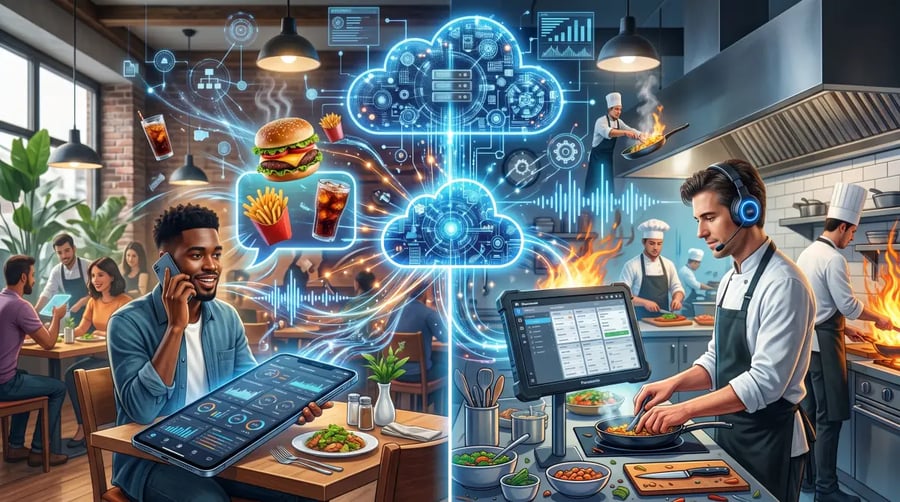
For generations, the telephone has been the humble piece of technology keeping restaurants going, fielding orders and linking customers with the restaurant team. However, in recent years, labor shortages and increased online ordering have created a problem that has seeped into the restaurant industry: unanswered calls.
Today, a ringing phone during the dinner rush can be just one more task that restaurant teams, often stretched thin, have to contend with. Each week, restaurants across the US receive over 200 million phone calls, and about 43% go unanswered. While the reasons for unanswered phone calls vary, from busy staff to focusing on serving in-person customers, the negative impact of unanswered calls is hard to ignore.
VoiceBit.AI is showing restaurant leaders that the era of the unanswered call doesn’t have to be permanent. This AI voice platform is designed to answer phone calls, take orders, process direct orders, respond to customer questions, coordinate delivery and pickup, and help restaurants improve the customer experience.
The impact of missed calls
Missed phone calls to restaurants mean more than just missed orders or lost sales. A frustrated caller may abandon not only their order but also the restaurant entirely as an option going forward. In an industry where margins are already razor-thin, losing customers in droves due to unanswered phone calls is not something many restaurants can afford.
This issue is especially acute for independent restaurants. Large chains often have call centers, online ordering platforms, or a robust customer service infrastructure to field questions and orders. In contrast, independent, “mom-and-pop” restaurants often operate with lean teams. It is critical that every labor effort is allocated to produce maximum impact. During busy periods, that can mean having to choose between answering the phone and serving in-house customers, cooking, prepping, packing delivery orders, and ringing people up. It’s easy for the phone to become an afterthought.
“The rise of online ordering has made ordering more convenient, but it has also shifted control,” says Jay Patel, CTO of VoiceBit.AI. “Before, the customer relationship may have suffered when their calls went unanswered. But now, restaurants have the power not only to answer each one of those calls but also to foster more long-standing relationships with their customers.”
VoiceBit.AI is built on the idea that restaurants can use modern automation technology without sacrificing the customer connection.
An AI system for every question and every phone order
VoiceBit.AI acts as an AI-powered receptionist for restaurants that can be available when staff is otherwise engaged in restaurant operations. Rather than leave customers in limbo or direct them to an impersonal voicemail box, the VoiceBit.AI system can answer every call around the clock, take pickup and delivery orders, process payments, and address customer questions.
“The technology works as an extension of the restaurant’s customer service, not a replacement,” says Patel.
If a customer query needs human intervention, VoiceBit.AI’s system can route it to a human staff member. This distinction is important because no two calls to a restaurant are the same. While one customer might want information on allergens, another may want to book a party. The value of VoiceBit.AI is not that it can speak, but that it can move customer service forward and recognize when human intervention is necessary.
The system's greatest value, however, comes from the time and breathing room it gives restaurant staff, especially during the busiest parts of the day. With VoiceBit.AI, the first layer of communication can be handled while staff focus on more productive activities in person.
Direct ordering and customer management
VoiceBit.AI is not just a phone answering system. The phone agent is merely one part of the platform’s overall approach. The company also offers branded web ordering, customer management, SMS marketing, delivery coordination, and loyalty programs. All of this is meant to strengthen customer relationships in the age of automation.
“Restaurants need tools not just to keep order volume up, but to convert first-time buyers into loyal customers,” explains Patel.
With VoiceBit.AI, an inbound customer call becomes part of an entire customer connection ecosystem. A guest who places an order may later receive a link prompting them to reorder or inviting them to a loyalty program. Rather than treating orders as isolated events, VoiceBit.AI lets restaurant teams create an entire strategy around customer service.
Technology in hospitality
Even as AI technology improves, some skepticism remains surrounding artificial intelligence in the restaurant industry. Customers may worry about getting stuck in an automated phone tree, while restaurant owners may feel that AI technology makes customer interactions impersonal.
“Personal interactions mean everything in hospitality,” says Patel. “The goal is not to replace hospitality with automation, but to allow the dedicated staff to be attentive to the dining room and those interactions that make all the difference.”
Restaurant technology has already transformed payments, ordering, delivery, loyalty, and even kitchen operations. Now, with VoiceBit.AI, every customer call gets answered, allowing restaurants to protect their revenue and their relationships with customers.
Copyright © 2026 California Business Journal. All Rights Reserved.
For California Business Journal Disclaimers, go to /terms-conditions/.