The $6 Billion Phantom Economy
Let's be real. The global sports industry is no longer about passive media consumption; it has mutated into a high-frequency financial exchange. Millions of viewers used to sit on their couches and simply watch a broadcast. Today, they actively trade on the outcome of a quarterback's next dropback. The math behind this shift is frankly terrifying. We are staring down the barrel of a $92 billion online wagering sector by 2031. This explosion transcends relaxed gambling laws or cultural shifts. We are looking at a masterclass in behavioral engineering; modern mobile sportsbooks operate with the velocity of institutional trading floors. They process thousands of concurrent transactions a second while dynamically adjusting probability matrices via machine learning. Broadcast latency is now a massive liability. Bettors demand real-time execution, prompting Wall Street quants to abandon hedge funds and build these exact models.
Frankly, the irony here is thick. Silicon Valley builds the exact infrastructure powering this nationwide gold rush, yet California residents cannot legally place a single digital wager. The Golden State represents the ultimate white whale for commercial operators. Analysts project a $6 billion untapped market currently trapped in legislative gridlock. Enterprise software developers in San Jose should absolutely be taking notes anyway. Smart product managers should view this entire space as a brutal, live-fire testing ground. It proves exactly how to master dynamic pricing and squeeze every ounce of retention out of a user base.
Sovereignty, Syndicates, and the Existential Threat
You have to understand the political minefield to grasp why California operates in a legislative blackout. Native American tribes dictate the state's gambling framework. These nations generate around $8 billion annually from 66 casinos; they fiercely guard this exclusivity to fund critical healthcare and education for their sovereign communities. DraftKings and FanDuel botched this dynamic in 2022. Corporate giants poured hundreds of millions into Proposition 27, attempting to bypass physical tribal casinos with a heavily taxed mobile betting framework. Voters incinerated the measure at the polls by an 83% margin.
The reality is that any path forward runs exclusively through Indian Country. Executive teams have since tucked their tails, shifting from hostile political takeovers to white-label collaborations. A newly proposed framework envisions a unified tribal syndicate managing a closed digital market by 2028 or 2030. Massive commercial corporations would shoulder the financial risk of ballot initiatives, while the tribes maintain ultimate ownership and guaranteed revenue floors.
An existential threat is quietly accelerating this standoff. Offshore prediction markets and decentralized sweepstakes platforms are aggressively bleeding out potential revenue from tribal borders. Rogue platforms operate in a murky legal gray zone, bypassing the rigorous consumer protections of Class III gaming. If these financial forecasting exchanges entrench themselves, the tribes' hard-fought exclusivity loses its intrinsic value. Market cannibalization is forcing tribal leadership to play offense before their monopoly permanently evaporates into the digital ether.
Wall Street Mechanics in a Vegas Wrapper
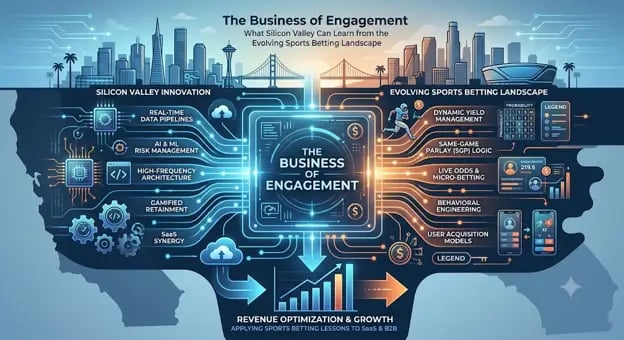
Look closer and you will realize a modern betting app is not a static e-commerce storefront. It is an adversarial, hyper-volatile trading floor. State synchronization acts as the absolute core of the business model. A single fumble alters the implied probability of the final score, requiring sub-50-millisecond global updates to millions of active client devices. You cannot achieve this exact precision with legacy request-response architectures. Top platforms rely heavily on event brokers like Apache Kafka and distributed caching via Redis Clusters to manage the relentless firehose of live data from official league APIs.
Artificial intelligence eradicates the manual oddsmaker in this environment. Complex models built on PyTorch and TensorFlow ingest tens of thousands of data points—live match statistics, aggregate betting volume, and liability exposure—to calculate dynamic pricing without human intervention. Algorithms instantly adjust the lines to balance the book if heavy public capital targets one side. Risk management is now entirely automated.
The entire landscape is a technological arms race against the users themselves. Professional betting groups write custom code just to hunt for lag. You have arbitrage scripts ripping through fifty different books simultaneously; they wait for a fraction of a second where prices diverge and steal the margin instantly. For a Silicon Valley engineer, this battlefield is the ultimate architectural stress test. The core logic powering a value-betting bot translates flawlessly to high-frequency stock trading, supply chain bidding, or automated ad inventory purchasing.
The Margin Engine: Gamifying the Edge
Behind the server racks, user interface design dictates who wins the market share war. Two titans, DraftKings and FanDuel, currently control nearly 70% of the domestic market. Both companies built their empires on daily fantasy sports. That pivot gave them millions of active credit cards before legal wagering even launched. FanDuel keeps players addicted by obsessing over speed—think instant Apple Pay deposits and native live streams. DraftKings takes the opposite route with a dense, heavily analytical interface. They want you digging through endless player props and customized carousels tied to their loyalty tiers.
The masterstroke of this entire industry is undeniably the Same-Game Parlay (SGP). Operators allow users to bundle highly correlated bets from a single event into one massive, lottery-style payout. The catch? The mathematical edge the house holds on these parlays is astronomical. Humans are notoriously terrible at calculating compound probabilities, and the algorithmic pricing engines know it.
These combination wagers now account for over a third of gross gaming revenue for major operators. They transform minor moments in a broadcast into intense, play-by-play financial thrillers. Data teams monitor the opening NFL odds closely. Their actual objective, however, is seamlessly funneling those new players toward high-margin SGP products.
Micro-wagering pushes the envelope further. A user betting on the speed of the next pitch or the exact outcome of a single offensive drive creates a hyper-accelerated dopamine loop that rivals the stickiest mobile games ever deployed.
Raw Revenue and the B2B SaaS Playbook
Software-as-a-Service executives need to study this ecosystem immediately. Few industries outside of digital wagering face such violent, synchronized traffic spikes. The Super Bowl kickoff drives millions of concurrent users to log in, deposit funds, process identity checks, and execute complex financial transactions simultaneously. If a database locks up, the operator bleeds tens of millions of dollars in seconds. Enterprise companies that routinely crash during end-of-month reporting cycles can learn massive lessons from this microservice-heavy, event-driven resilience.
Raw revenue optimization translates instantly across sectors. A sportsbook’s product is simply a dynamic price tag that reflects liability and market demand. Cloud computing providers or gig-economy platforms can easily implement the exact same reinforcement learning models. These enterprise platforms could automatically hike API pricing during peak server load and offer steep discount incentives when data centers sit idle.
User churn remains the final, most brutal battlefield. The switching cost between competing betting applications is virtually zero. Operators survive by ruthlessly eliminating friction from the user journey. Biometric logins, Venmo integrations, and frictionless cross-product wallets ensure the user is never more than three seconds from a desired action. Every single nested menu or delayed API response in a B2B application represents a critical point of failure. The convergence of media, tech, and digital finance is already operating at peak velocity. The smartest minds in San Jose must stop viewing the sportsbook merely as a vice, and start recognizing it as the absolute blueprint for the next decade of digital enterprise.