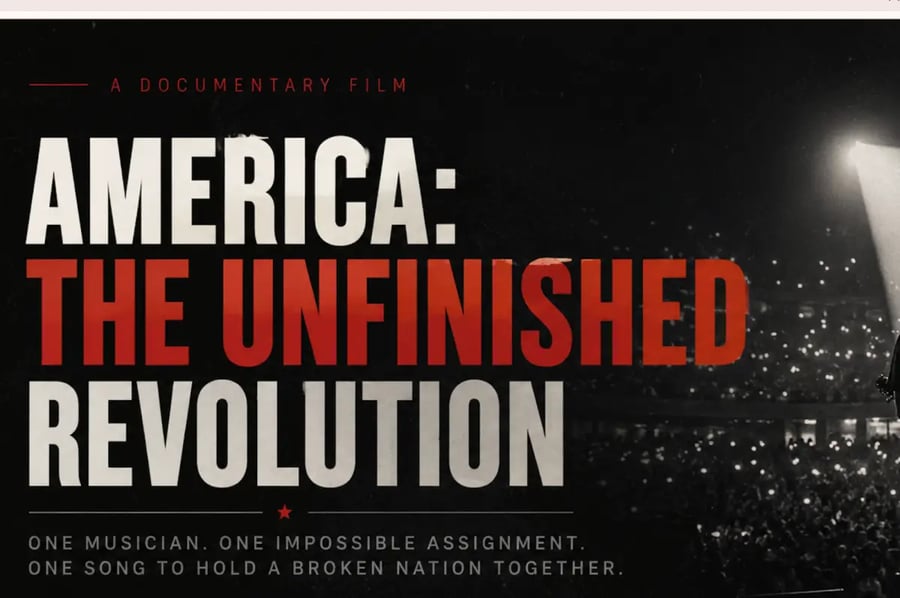
In this, America's 250th year, we are being asked to celebrate a nation many of us no longer recognize or identify with, as it drifts farther and farther away from what it promised to become. We inhabit the same country, but increasingly not the same reality. We receive different facts, trust different institutions, and encounter one another through systems built to reward speed, outrage, and division.
This is more than a political crisis. It is a crisis of identity. A country holds together not only through laws and elections but through a shared understanding of who its people are and what they share, and quite frankly, owe one another if they are to remain “a people.” When citizens stop believing they share a story, they stop believing they belong to each other.
That is why I started an organization called Somewhere I Read.
The name comes from the last speech of Martin Luther King Jr.'s life. Speaking in Memphis on April 3, 1968, King invoked the freedoms of assembly, speech, and the press, then declared: "somewhere I read that the greatness of America is the right to protest for right." He was assassinated the next day. Even on the eve of his death, King did not abandon America's written promise. But rather, he claimed it, and celebrated at his usual volume of glory, and used it as a moral instrument against America's decaying reality.
I believe that declaration, that all are created equal, endowed with rights no king or government can rightfully grant or revoke, is one of the most beautiful ideas ever put into words. Not because the men who wrote it governed justly. They didn't. They presided over enslaved brothers and sisters, promoted disenfranchisement, and lived in neon hypocrisy as the men who penned some of the most noble sentences in history that would certainly not describe the country they had actually built. But…and this is one of the greatest “however”s in history as well - it described a possibility powerful enough to outlive them, one that the rest of us, most of us anyway, would spend two centuries cashing. They put forth a mighty and majestic proposition - they created an aspirational nation.
This has become even more urgent, again, in the age of artificial intelligence, as the media systems shape which stories we see, which voices get amplified, and which version of reality we're handed before we can even live a shared truth together. Our experience of life itself is being curated before our feet hit the streets. The question isn't whether media and technology shape national identity, they most certainly already do. It's whether citizens remain the authors of that identity, or become its passive consumers.
I did not arrive at this conviction abstractly. My eldest half-brother discovered and managed Bruce Springsteen, and I grew up watching how a song could move through a stadium and become part of a nation's emotional vocabulary and how an artist could love a country without flattering it, could honor working people without sentimentalizing their suffering. Long before I read John F. Kennedy's 1963 tribute to Robert Frost at Amherst, in which he said the artist maintains "a lover's quarrel with the world," and that "when power corrupts, poetry cleanses", I had already seen that quarrel lived out through music. I understood artists were critical of society because they loved what we could become. They were determined to deliver us to our better angels. And, yes, sometimes the truth hurts on your way there.
Indifference doesn't quarrel with anything. It walks away. It gives up. It folds. But the artist, courageous and bold by nature, who sees the distance between what a country is and what it could be, will keep pressing precisely because they care. Criticism can be an act of fidelity.
My own relationship with America is not so dissimilar. I love it too much to reduce patriotism to praise or pageantry or a cheap grifters nationalism. I love its founding proposition too much to pretend we've fulfilled it. I love it too much to take a lazy, greedy, self involved respite in my own privilege. I love it too much - to give up.
That belief in what art can do isn't only philosophical for me. A few days after I turned eighteen, just before starting college, my mother died suddenly of a stroke. Days after her death, I was dropped off alone at NYU, where I'd won an acting scholarship, while my father left to start a new life elsewhere. Inside, I was shattered.
Sometime that first year, I wandered into a movie theater because it was the only place I knew to go when everything else around me was crumbling. The film was A Bronx Tale, and its line about wasted talent didn't land for me as a warning about unrealized fame, but rather, it landed as the tragedy of never becoming who you were capable of becoming. I walked out shaking with a new found inspiration and a determined hope to live. I had experienced love and grace, alone, in that dark downtown theater. I went straight to Pearl Paint on Canal Street, bought the largest canvas I could carry back to my dorm on 5th ave and 10th street, and right there on my little NYU cot/bed, painted my mother's sunflowers from the one photograph I had of her garden. One flower had passed, and one was only starting to bloom.
That painting saved me. More than thirty years later, I still have it. I called it Emergence - one flower withering, another still pushing through. It taught me art can interrupt despair, translate grief into form and even passion and hope, and can hand deliver agency back to someone who feels life has already been decided for them. I also knew what it could do for one person, it could do for a nation.
Somewhere I Read is my attempt to put that belief to work by using film, education, music, technology and honest and comprehensive history to help Americans remain the authors of their own national story, rather than passive recipients of one written by algorithms or institutions or media moguls on their behalf. It is not an effort to flatter America. It is an effort to tell the truth about it while refusing to give up on its great promises and what it claims to be.
As we move through this 250th year, survival is too modest a standard for a republic founded on the dignity of the individual person and the pursuit of happiness - of all we can become. It has been noted that The Statue of Liberty is not standing still. She is walking. Why, we ask? As Dave Eggers theorizes in his wonderful children’s book Her Right Foot, she is not content to wait. She must greet them in the sea… Give me your weary and poor. Yes, Come to our shores. We have so much to give you here. That was the dream…
Will we become worthy of what was written in our name ? Will we protect the freedom of the individual mind in an age of algorithmic influence, teach our history honestly enough to learn from it and lovingly enough to still believe in it, and treat dissent as a democratic duty rather than a betrayal? Will we love our brother and sister? Will we, in fact, become “a people?”
Somewhere I read that America could become what it declared itself to be…some 250 years ago. You in? Let’s roll.
Copyright © 2026 California Business Journal. All Rights Reserved.
For California Business Journal Disclaimers, go to /terms-conditions/.