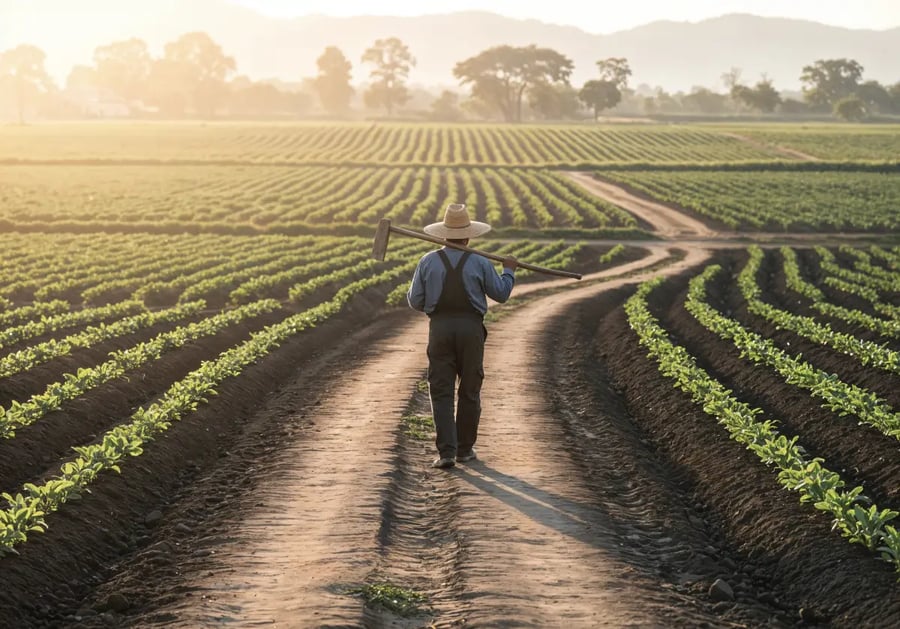
When Navya Rajan began thinking seriously about farmers, she was thinking about family stories.
Her grandparents had spoken about land, early mornings, and the exhaustion of fieldwork. Then, during a school trip in Chennai, she saw people working in a forested area and felt the distance between knowing a problem exists and actually seeing it.
“Urban life” can make people underestimate agricultural labor, she says.
Her first attempt to help farmers looked like a business plan. She wanted to replace plastic medicine blister packs with packaging made from sugarcane waste, or bagasse, a material commonly discarded in South India. The idea had two aims: to reduce plastic and give farmers a way to earn from something they would otherwise throw away.
For a while, the plan seemed possible. Navya created a pitch deck, found a potential bagasse supplier, spoke with a sales expert, and tried to connect with a university researcher. But unanswered emails, scheduling problems, and manufacturing limits stalled the project. No manufacturer was willing to produce even a small batch of bagasse-based products instead of plastic.
By late March, after nearly three months of waiting, she had her answer. “It completely, utterly failed,” she says. But the reason she had started it had not disappeared.
If anything, the failure clarified the work. Navya had wanted to help farmers all along. The bagasse project would have done that indirectly, through a product and many middlemen. Now she began asking a simpler question: if the goal was farmer welfare, what could she do herself, with fewer middle steps, that would matter immediately?
She thought of what her grandparents had told her about farmers often suffering injuries to their feet from snake bites, insect bites, prickly ground, and working in the dark.
That question led her to safety.
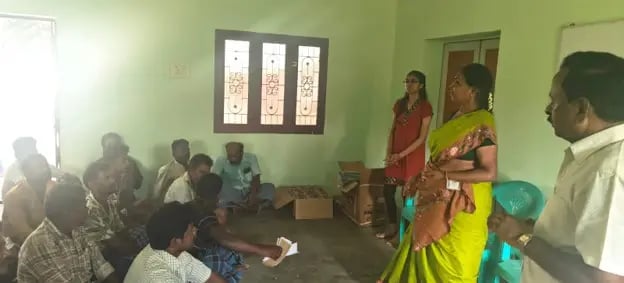
Navya then joined hands with TAPWA NGO, which confirmed that many of the farmers collected jasmine flowers at 2 or 3 a.m., often without boots or lamps. She learned that one farmer had recently been stung by a snake, and another had been bitten by an insect. The incidents made the need feel immediate.
The more she asked, the clearer it became that boots and headlamps were the practical starting point. She did not want to buy something that looked useful from a distance but would sit unused. Working with TAPWA NGO and local farming communities, she organized an online fundraiser to purchase safety equipment for 50 farmers in South India. The fundraiser raised a little over 700 USD.
Because she is under 18, setting up the fundraiser meant navigating account restrictions, paperwork, and a cap on how much she could raise. Once the money came in, she still had to make it stretch: 70,000 INR had to cover boots, headlights, and delivery for about 50 farmers. Buying the equipment herself meant comparing quality and price across agricultural websites instead of standard retail sites.
That was where the project began to draw on a different path in her life. Navya had grown up around conversations about money. As a child, she listened to her father talk about banking, taxes, and financial systems. In India, while living with her grandparents, she managed household money from eighth grade onward. At a fintech internship, she learned to research, organize information, prepare written materials, and make ideas persuasive for different audiences.
Those skills showed up in the fundraiser. She wrote appeals for friends, parents, relatives, and supporters. She sent WhatsApp messages, used Instagram, and learned that even when people could not donate, asking them to spread the word mattered. She also used the same research discipline to narrow down equipment options, balancing cost against quality.
The project also forced her to think beyond spreadsheets. When she delivered the first set of supplies, one farmer raised a concern that stayed with her. The boots and headlamps, he told her, might wear out in six months. Seeds or other long-term support, he suggested, could help more. Navya understood the point, but she also saw something else beneath it: safety had been pushed so far down the list that risk had become normal.
To her, that was exactly the problem. “Safety is the ground rule for anything,” she says. “You need to be alive to enjoy whatever you have.”
It also taught her what trust looks like in practice. When she arrived with the supplies, an NGO leader told her he had not been sure she would turn up. Her arrival changed the relationship. Saying something mattered less than showing up.
Navya is now building a website or blog to document the project, share updates, and explain why farmer safety deserves attention. She is already thinking beyond the first delivery: raincoats, seeds, cattle, and support that does not rely only on repeated fundraisers. For now, though, the first step is concrete: boots on feet, light in the dark, and a reminder that the people who grow food deserve to return from the fields safely.
Copyright © 2026 California Business Journal. All Rights Reserved.
For California Business Journal Disclaimers, go to /terms-conditions/.