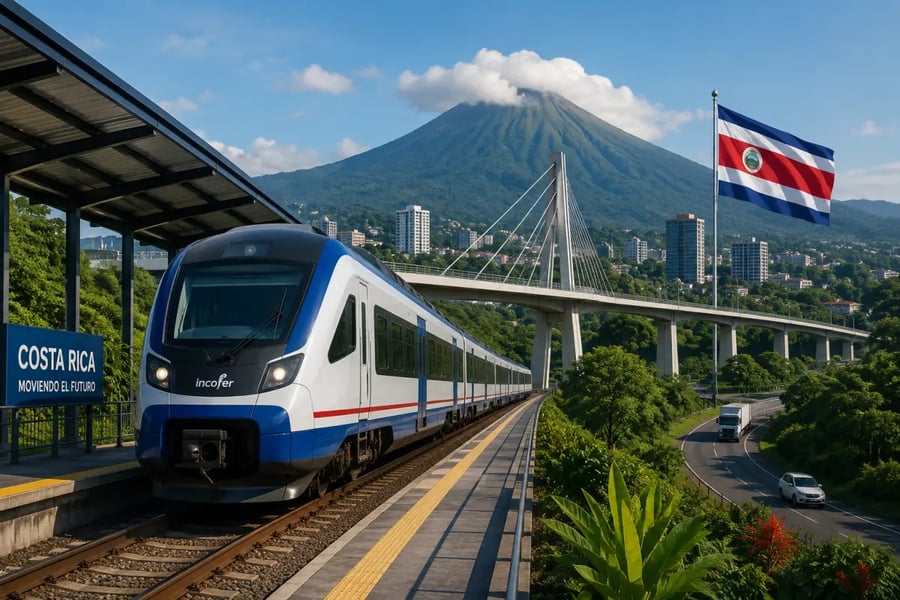
WRA Environmental Engineering, Inc., together with Ecotravía Global Holding and the designated Costa Rican project entities, has formally submitted to the National Concessions Council (CNC) an ambitious private initiative proposal known as the Costa Rica National Railway and Infrastructure Platform.
This strategic proposal is designed to consolidate a robust multi-coastal logistics system, promote complementary mobility, generate specialized employment, and strengthen the country's long-term resilience and international competitiveness.
The submission of this file marks the beginning of the formal process for its evaluation and analysis by the competent institutional authorities. The proposal has been structured under a rigorous fiscal-discipline model that provides for strictly private financing and therefore does not contemplate direct public-capital contributions for construction, sovereign guarantees, availability payments, or minimum revenues guaranteed by the State, which would at all times retain its full governing, regulatory, and supervisory functions.
"This is not merely a railway. It is a national platform for employment, training, ports, trade, resilience, and long-term opportunities for the Costa Rican people,” says Cornel Alvarado, President of WRA Environmental Engineering, Inc.
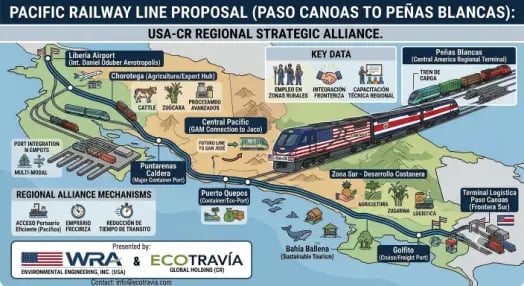
Territorial Structure and Long-Term Geopolitical Vision
To ensure unified technical planning, the project establishes a rigorous territorial control sequence divided into strategic phases:
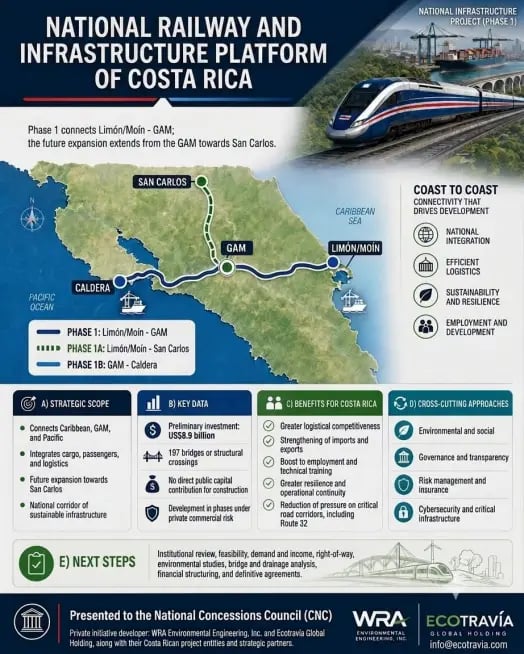
Phase 1 (Caribbean-GAM-Caldera): Defined as the fundamental priority corridor. It will efficiently connect Moín/Limón, Siquirres, Turrialba, Cartago, San José/GAM, and Caldera, optimizing bulk-freight transportation and interoceanic logistics between the Atlantic and Pacific.
Phase 1A (San Carlos Branch): A strategic branch extending from Siquirres and Ticabán to San Carlos, intended to directly connect the country's fertile and dynamic northern agricultural and productive region, subject to the corresponding feasibility validations.
Phase 2 (Connection with Panama): A future expansion planned toward the southern border, whose final viability and implementation will be subject to appropriate binational coordination, demand studies, environmental variables, and financial structuring.
Phase 3 (Connection with Nicaragua): A long-term vision designed to interconnect the system northward, consolidating the platform as a major regional logistics hub in the Americas.
Advanced Engineering, Resilience, and Technical Parameters
Phase 1 includes a preliminary control figure of approximately 197 bridges or structural crossings. Each of these structures will undergo comprehensive field inspections, hydrological, hydraulic, and geotechnical analyses, and seismic evaluations to determine individually the need for rehabilitation, reconstruction, or complete replacement.
At the engineering-design level, the platform proposes adopting a standard track gauge of 1,435 millimeters and a hybrid operation (diesel/biodiesel) capable of evolving toward new clean technologies. To optimize capital costs and accelerate initial deployment, the base case does not include overhead catenary systems; however, it prioritizes advanced drainage and structural-protection systems against extreme climatic events such as severe rainfall, flooding, slope instability, and seismic activity.
Environmental Sustainability, Citizen Participation, and Local Talent Development
The initiative's development will be rigorously aligned with Costa Rica's legal framework, fully complying with Organic Environmental Law No. 7554 and the directives issued by the National Environmental Technical Secretariat (SETENA), the Ministry of Environment and Energy (MINAE), and other competent entities, without the project's current status implying advance environmental approval.
It is also formally established that community participation within the project's area of influence would be conducted through the National Confederation of Community Development Associations (CONADECO) and its respective community associations, creating an institutionalized and democratic channel for local development.
In parallel, the project places the human factor at the center of its strategy through a comprehensive technical training program beginning on "Day 1." This special program will train Costa Rican professionals in key disciplines such as railway operations, rail traffic dispatch, infrastructure and bridge maintenance, mechanics, power electricity, yard and workshop management, international logistics, operational safety, and administration.
Governance and Next Steps
Project evaluation rests with State institutions within the framework of their legal authority, including the National Concessions Council (CNC), the Ministry of Public Works and Transport (MOPT), the Costa Rican Railway Institute (INCOFER), sector regulators, and municipalities. Reference to these entities reflects the governance pathway and does not constitute prior approval or a government financial commitment.
The immediate roadmap includes an evaluation of admissibility and public interest, followed by the formal development of definitive studies covering the route, market demand, right-of-way management, environmental impact, social mitigation, operational optimization, and the financial and legal due diligence that will guide the definitive agreements.
PRESS CONTACT
Entity: Ecotravía Global Holding & WRA Environmental Engineering, Inc.
Email: info@ecotravia.com
Headquarters: San José, Costa Rica
CONTROL AND FORWARD-LOOKING STATEMENT: This press release contains forward-looking statements and preliminary planning assumptions. Nothing contained in this document constitutes an offer of securities, a guarantee of future results, implied institutional approval, advance environmental approval, a commitment to financial closing, or any obligation for the Government of the Republic of Costa Rica. The financial, infrastructure, and contractual figures are indicative values subject to final validation, pre-feasibility, and feasibility studies.
==============================
PLATAFORMA NACIONAL FERROVIARIA Y DE INFRAESTRUCTURA DE COSTA RICA
Propuesta Integral para la Transformación de la Infraestructura Interoceánica
WRA Environmental Engineering, Inc., junto con Ecotravía Global Holding y las entidades designadas del proyecto en Costa Rica, ha presentado formalmente ante el Consejo Nacional de Concesiones (CNC) una ambiciosa propuesta de iniciativa privada denominada Plataforma Nacional Ferroviaria y de Infraestructura de Costa Rica. Esta propuesta estratégica está diseñada para consolidar unsistema logístico multicoastal robusto, promover la movilidad complementaria, generar empleo especializado y fortalecer la resiliencia a largo plazo y la competitividad internacional del país.
La presentación de este expediente marca el inicio del proceso formal para su evaluación y análisis por parte de las autoridades institucionales competentes. La propuesta ha sido estructurada bajo un riguroso modelo de disciplina fiscal que contempla un financiamiento estrictamente privado y, por lo tanto, no prevé aportes directos de capital público para la construcción, garantías soberanas, pagos por disponibilidad o ingresos mínimos garantizados por el Estado, el cual conservará en todo momento sus plenas funciones de gobernanza, regulación y supervisión.
"Esto no es meramente un ferrocarril. Es una plataforma nacional para el empleo, la capacitación, los puertos, el comercio, la resiliencia y las oportunidades a largo plazo para el pueblo costarricense." — Cornel Alvarado, Presidente de WRA Environmental Engineering, Inc.
Estructura Territorial y Visión Geopolítica a Largo Plazo Para asegurar una planificación técnica unificada, el proyecto establece una secuencia rigurosa de control territorial dividida en fases estratégicas:
Fase 1 (Caribe-GAM-Caldera): Definida como el corredor prioritario fundamental. Conectará de manera eficiente Moín/Limón, Siquirres, Turrialba, Cartago, San José/GAM y Caldera, optimizando el transporte de carga a granel y la logística interoceánica entre el Atlántico y el Pacífico.
Fase 1A (Ramal San Carlos): Un ramal estratégico que se extiende desde Siquirres y Ticabán hacia San Carlos, destinado a conectar directamente la fértil y dinámica región agrícola y productiva del norte del país, sujeto a las validaciones de factibilidad correspondientes.
Fase 2 (Conexión con Panamá): Una expansión futura planificada hacia la frontera sur, cuya viabilidad e implementación final estarán sujetas a la coordinación binacional adecuada, estudios de demanda, variables ambientales y estructuración financiera.
Fase 3 (Conexión con Nicaragua): Una visión a largo plazo diseñada para interconectar el sistema hacia el norte, consolidando la plataforma como un importante centro logístico regional en las Américas.
Ingeniería Avanzada, Resiliencia y Parámetros Técnicos
La Fase 1 incluye una cifra preliminar de control de aproximadamente 197 puentes o cruces estructurales. Cada una de estas estructuras se someterá a inspecciones de campo exhaustivas, análisis hidrológicos, hidráulicos y geotécnicos, así como a evaluaciones sísmicas para determinar de manera individual la necesidad de rehabilitación, reconstrucción o reemplazo completo.
A nivel de diseño de ingeniería, la plataforma propone adoptar un ancho de vía estándar de 1,435 milímetros y una operación híbrida (diésel/biodiésel) capaz de evolucionar hacia nuevas tecnologías limpias. Para optimizar los costos de capital y acelerar el despliegue inicial, el caso base no incluye sistemas de catenaria aérea; sin embargo, prioriza sistemas avanzados de drenaje y protección estructural contra eventos climáticos extremos como lluvias severas, inundaciones, inestabilidad de taludes y actividad sísmica.
Sostenibilidad Ambiental, Participación Ciudadana y Desarrollo del Talento Local
El desarrollo de la iniciativa estará rigurosamente alineado con el marco legal de Costa Rica, cumpliendo plenamente con la Ley Orgánica del Ambiente No. 7554 y las directrices emitidas por la Secretaría Técnica Nacional Ambiental (SETENA), el Ministerio de Ambiente y Energía (MINAE) y otras entidades competentes, sin que el estado actual del proyecto implique una aprobación ambiental anticipada.
Asimismo, se establece formalmente que la participación comunitaria dentro del área de influencia del proyecto se canalizará a través de la Confederación Nacional de Asociaciones de Desarrollo Comunal (CONADECO) y sus respectivas asociaciones comunitarias, creando un canal institucionalizado y democrático para el desarrollo local.
En paralelo, el proyecto coloca al factor humano en el centro de su estrategia a través de un programa integral de capacitación técnica que iniciará desde el "Día 1". Este programa especial capacitará a profesionales costarricenses en disciplinas clave como operaciones ferroviarias, despacho de tráfico ferroviario, mantenimiento de infraestructura y puentes, mecánica, electricidad de potencia, gestión de patios y talleres, logística internacional, seguridad operacional y administración.
Gobernanza y Próximos Pasos
La evaluación del proyecto corresponde a las instituciones del Estado en el marco de sus competencias legales, incluyendo al Consejo Nacional de Concesiones (CNC), el Ministerio de Obras Públicas y Transportes (MOPT), el Instituto Costarricense de Ferrocarriles (INCOFER), los reguladores del sector y las municipalidades. La mención a estas entidades refleja la ruta de gobernanza y no constituye una aprobación previa ni un compromiso financiero gubernamental.
La hoja de ruta inmediata incluye una evaluación de admisibilidad e interés público, seguida por el desarrollo formal de estudios definitivos que abarquen la ruta, la demanda del mercado, la gestión del derecho de vía, el impacto ambiental, la mitigación social, la optimización operativa y la debida diligencia financiera y legal que guiará los acuerdos definitivos.
CONTACTO OFICIAL DE PRENSA
Entidad: Ecotravía Global Holding & WRA Environmental Engineering, Inc.
Correo electrónico: info@ecotravia.com
Sede: San José, Costa Rica
DECLARACIÓN DE CONTROL Y PROYECCIÓN FUTURA: Este comunicado contiene declaraciones con miras al futuro y supuestos preliminares de planificación. Nada de lo contenido en este documento constituye una oferta de valores, una garantía de resultados futuros, aprobación institucional implícita, aprobación ambiental anticipada, un compromiso de cierre financiero o una obligación alguna para el Gobierno de la República de Costa Rica. Las cifras financieras, de infraestructura y contractuales son valores indicativos sujetos a validación final, estudios de prefactibilidad y factibilidad.
Copyright © 2026 California Business Journal. All Rights Reserved.
For California Business Journal Disclaimers, go to /terms-conditions/.