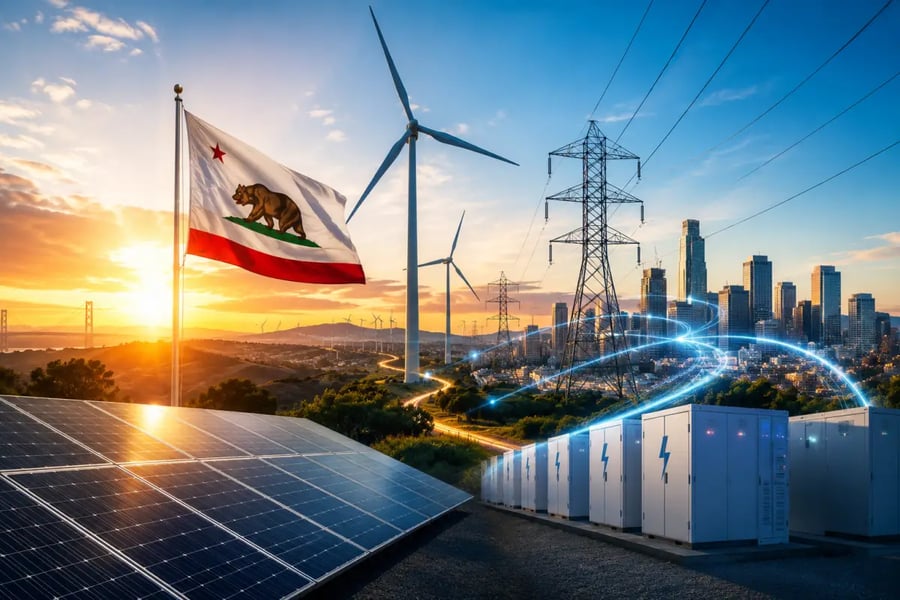
From semiconductors and aerospace to biotechnology, software, artificial intelligence, and clean technology, the state of California has spent decades defining the industries that shape the global economy. Silicon Valley became synonymous with innovation because it consistently solved problems before the rest of the world recognized they existed.
Today, however, California faces a different challenge.
Innovation alone is no longer enough.
As AI transforms every sector of the economy, the conversation is shifting from software to infrastructure. The companies building tomorrow's technologies are increasingly constrained not by talent or investment, but by something far more fundamental: access to reliable, scalable energy.
The next era of business competitiveness will belong to those who can generate, store, and control their own power.
That represents both one of California's greatest challenges and one of its greatest opportunities.
Artificial intelligence is dramatically increasing electricity demand. Every new data center, manufacturing facility, autonomous logistics network, and advanced robotics deployment requires enormous amounts of dependable power. Morgan Stanley recently identified energy infrastructure as one of the defining investment themes of 2026, arguing that AI, energy security, and industrial modernization are increasingly becoming inseparable.
Businesses are beginning to recognize a simple reality: energy has become a strategic asset.
For decades, companies focused on lowering operational costs through outsourcing, digitization, and lean manufacturing. Today, executives are asking a different question.
How can we ensure uninterrupted operations regardless of grid constraints, market volatility, or extreme weather?
Across California, that question has become increasingly urgent.
Manufacturers, technology companies, agricultural producers, logistics operators, hospitals, and critical infrastructure providers all depend on continuous access to electricity. Even brief interruptions can cost millions in lost productivity, disrupted supply chains, or damaged equipment.
Resilience is no longer a luxury; it is becoming a competitive requirement.
This is where decentralized energy systems are beginning to reshape industrial strategy.
Rather than relying exclusively on centralized grids, businesses are exploring modular energy solutions capable of delivering reliable power closer to where it is needed. Hydrogen technologies, advanced storage systems, microgrids, and distributed generation are creating new possibilities for facilities that require uninterrupted operations while simultaneously pursuing sustainability objectives.
Companies such as VIVIFY Technology are part of this emerging movement, developing modular hydrogen-powered infrastructure designed to provide flexible, scalable energy solutions for industrial users seeking greater operational resilience.
For California businesses, this evolution extends beyond environmental policy.
It is about economic competitiveness.
The state's advanced manufacturing renaissance depends on dependable infrastructure. Semiconductor fabrication, aerospace production, precision manufacturing, pharmaceuticals, food processing, and AI computing all require power systems capable of supporting around-the-clock operations.
Without sufficient energy capacity, investment inevitably migrates elsewhere.
Fortunately, California continues to possess unique advantages.
Its universities produce world-class engineering talent. Its venture capital ecosystem remains unmatched. Its climate technology sector continues attracting billions in investment, while its entrepreneurs consistently commercialize emerging technologies faster than almost anywhere else in the world.
Those strengths position California to become a global leader not only in software innovation but in next-generation industrial infrastructure.
The companies that succeed during the coming decade will increasingly integrate digital intelligence with physical resilience.
Artificial intelligence may optimize operations, but it cannot compensate for insufficient electricity.
Automation may improve productivity, but factories cannot operate without dependable power.
Cloud computing may transform business models, but data centers require massive, uninterrupted energy supplies.
The digital economy ultimately depends upon physical infrastructure.
Goldman Sachs recently observed that AI's next investment wave will increasingly occur within the "physical economy" - factories, utilities, industrial facilities, transportation networks, and energy systems - where technology meets real-world production.
California has reached an inflection point.
The state can continue viewing energy primarily as a regulatory issue, or it can embrace it as an engine of economic growth and industrial competitiveness.
The latter offers enormous potential.
Businesses capable of generating greater energy independence will become more resilient against volatility, better positioned to attract investment, and more competitive in global markets.
That is especially important as manufacturing continues returning to North America and companies reassess supply chains through the lens of national security, resilience, and long-term reliability.
Industrial leadership has always depended on infrastructure.
Railroads powered the Industrial Revolution.
Highways transformed commerce.
Broadband enabled the digital economy.
Now energy resilience is becoming the foundation upon which the AI economy will be built.
California has spent decades leading technological revolutions.
Its next opportunity is to lead the infrastructure revolution that makes those technologies possible.
The future will not simply belong to those who invent the most sophisticated algorithms.
It will belong to those who ensure those algorithms never lose power.
Copyright © 2026 California Business Journal. All Rights Reserved.
For California Business Journal Disclaimers, go to /terms-conditions/.